Wednesday, November 10, 2010

The Reign of Terror


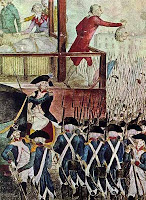
The French Revolution was a time of hardship and despair for French citizens, as each day was a battle just to maintain life. In the early 1790's, times became particularly difficult, especially for the poor. To resolve issues for the poor, the French government made a few radical economic changes that would supply the poor with food and work. Meanwhile, Maximilien Robespierre (depicted on the right) devised a system to solidify the French home front. This web of extremely intense courts was named the The central purpose of these courts was to try "enemies of the state" and other rebels for political crimes against France. This court had nearly unlimited power, as it answered only to Robespierre's Committee of Public Safety. Approximately forty thousand French people died via execution or while in prison, and another three hundred thousand were arrested for various crimes. These courts were created in an attempt to stabilize the French home front and force people to become more patriotic. However, looking back, these courts really only produced terror in the hearts and minds of people, rather than the patriotic feelings that these actions were meant to evoke. Not only were approximately forty thousand people killed for crimes they may or may not have committed, but also nearly three hundred thousand people were unnecessarily arrested. In hind sight, these arrests made people think not "wow, I could be arrested if I oppose France," but rather, "why would I service a country that accuses it's loyal citizens of crimes they did not commit?" These courts were soon to be realized for what they truly were, and Robespierre was soon unmasked as the evil man that he truly was, and in July of 1794 Robespierre was executed by the French government, thus lifting the dark blanket that the Reign of Terror had cast over all of France.
Tuesday, October 5, 2010

Patrick Henry - "Give Me Liberty or Give Me Death"

Give me liberty or give me death!!!" This famous quote is regarded as the one that truly began the American Revolution was made famous in a speech by Patrick Henry. He concluded his speech with this defiant statement, but it was the content of his speech that got the the colonies buzzing. He blatantly called out the British, explaining to the colonies how Americans had been pleading and begging for change, yet the British spit it back in our faces. He called for war on the British, and that the only way for the colonies to earn their independence was to battle and defeat the British. In his speech, he rhetorically questioned as to whether or not the revolution could be avoided, or was it inevitable. This speech was the culmination of the many factors that lead up to the American Revolution. It was the start of America's independence from Britain.
This image shows the American's passion for winning the war and gaining their independence. Patrick Henry had set off an explosion within Americans, and with the idea of "Give me liberty or give me death" burning strongly within them, there was no stopping the American storm. It swept through the colonies, touching each one and giving them that lust for freedom that had inspired Patrick Henry to give that incredible speech in 1775. Henry beleived that the Revolution was needed for the Americans, and that they were unable to push it off for any longer. So was the Revolution inevitable, or was there a way for the colonists and British to work it out, and possibly avoid their violent separation? Please leave your thoughts in the comments.


Picture 2 - http://lehrman.isi.org/catalog/resource/view/id/1519

Thursday, September 23, 2010

Charity vs. A Charitable Act

Today, in class we discussed the concept of charity vs. the concept of charitable actions. We defined charity as giving to charity, in the form of money or some other type of giving. A charitable action is the action of giving that includes some kind of personal sacrifice. Many people are charitable, because the give lots of money or material things to those less fortunate. However, these people, although their generosity is nice, are not really making any real sacrifice, and often these people make donations to make them selves feel better or more charitable. Those who make charitable actions, most often are making some type of sacrifice, whether it be their time or some kind of labor. Those who make charitable actions, I believe are more likely to be doing it to be helping others, rather than trying to make themselves feel better. Does this mean that the people who only give money to charity are not good people, no of course not. Those people who make donations are stilling giving up money that could be used on themselves directly, by purchasing a new movie, or video game, or cheeseburger that they don't really want. It's just that those who make charitable actions truly are giving up their own time and sacrificing to help others, which makes that person truly helpful to those who need it. People who make charitable donations often are spending the money on themselves in a way, because often those people feel better about themselves for donating and helping someone else. But to those who truly sacrifice for those less fortunate, I salute you.